Buying a house near Lisbon in our 20s

Last year, my girlfriend (24) and I (23) bought a house in Odivelas (yes, I know: it’s not technically Lisbon, but it is part of the Lisbon Metropolitan Area). It was a long process with several steps, so the objective of this post is to document our journey and possibly help someone who wants to do the same in Portugal.
Disclaimer: This is not professional financial advice. I won’t share specific personal details (like the exact house value or credit specifics), but I will use realistic examples to illustrate the process. Throughout the post, I’ll use Portuguese terms you’ll likely hear during the process, with English explanations alongside them.
Step 0: The Decision 🤔
First, you need to decide if buying is right for you. This is a very important decision that you need to make carefully. Nothing is permanent, but buying a house is not the same as buying a pair of pants (even though that can also be a difficult decision for me).
Consider renting vs. buying. Renting offers flexibility and less financial liability for repairs, while buying builds equity but ties you down. The trade-offs in Portugal are tricky right now; rents are high, but property prices are also at historic highs due to low supply and high demand.
For us, the decision was pretty clear — renting felt like throwing money away, and we had been saving for a couple of years.
You also need to decide if you are buying alone or with someone. Buying as a couple increases your borrowing power significantly, but it adds a layer of relationship commitment. Do not rush this step.
Step 1: Planning 📊
So, you’ve decided to buy. Now what? Before opening a real estate app, you need to know your budget.
Most young adults in Portugal can’t buy a house upfront, so you will likely need a bank loan (Crédito Habitação). The real question isn’t “how much does the house cost,” but “what is the maximum amount the bank will lend us?”
To get an estimate, use a simulator like the Simulador de compra de casa from Doutor Finanças. You’ll input your net monthly income, existing loan expenses, number of borrowers, and preferred interest rate type.
Example Simulation
Here is a result for a couple (both 25 years old) with the following profile:
- Net monthly income: 3.000 € (combined)
- Existing loans: 0 €
- Status: Both eligible for Youth IMT (IMT Jovem) exemption
- Down payment (Entrada): 20.000 €
- Rate type: Mixed rate (Taxa Mista)
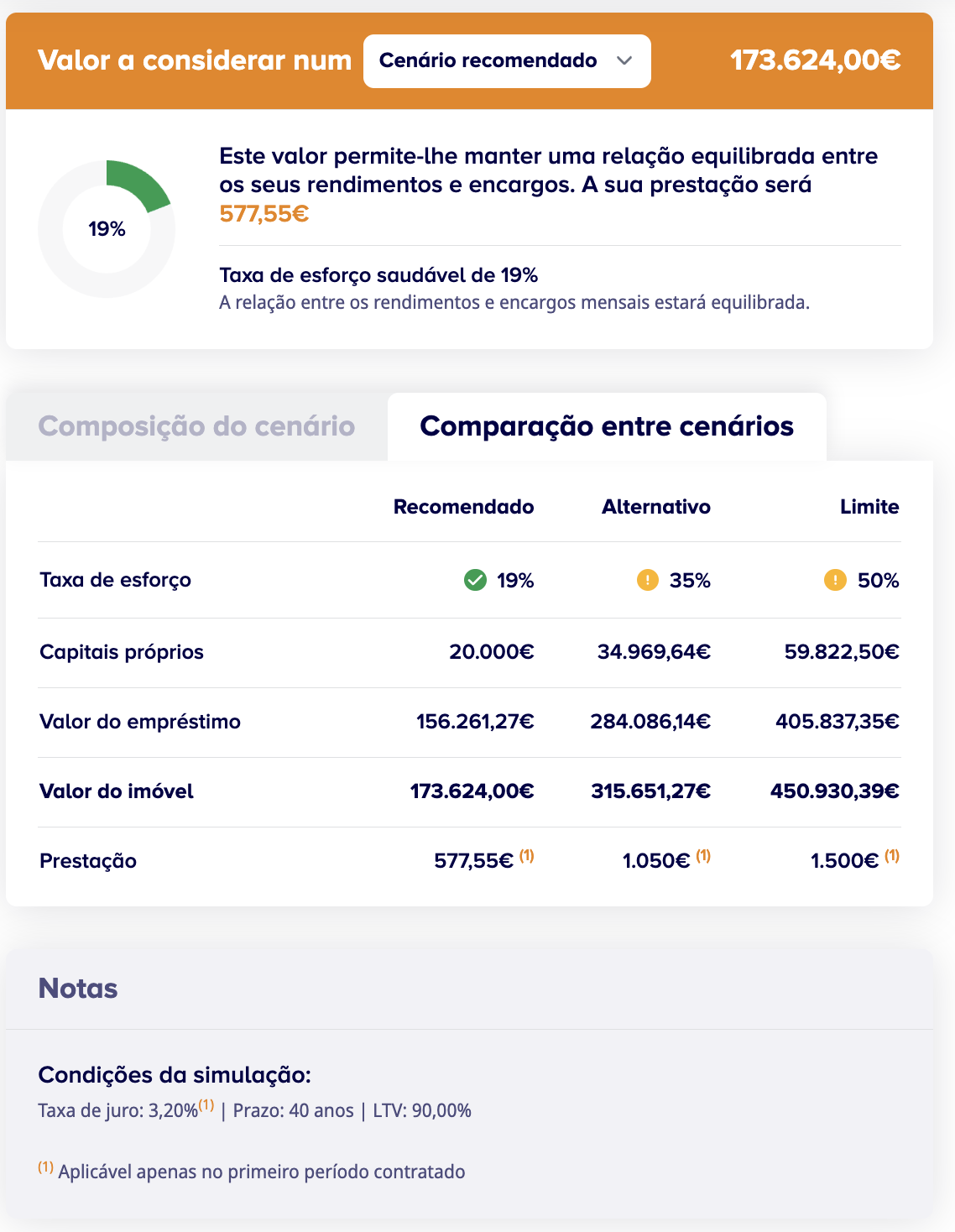
The most critical number here is the Effort Rate (Taxa de Esforço).
Effort Rate = Monthly Installment / Net Monthly Income
Banco de Portugal recommends this stays below 40%. Ideally, aim lower.
The “Hidden” Monthly Costs
Don’t just budget for the loan installment. You need a buffer for:
- Utilities: Electricity, water, gas, etc.
- Communications: Internet, phone, TV package.
- Insurance: Life and Home insurance (mandatory for loans).
- Living Expenses: Groceries, transport pass, gym, subscriptions.
- Your “wants”: Dining out, cultural events, clothes, etc.
- Savings & Investments.
Yeah, this is a lot to think about. I recommend making a spreadsheet with these categories and some realistic estimates. For example, we searched for average monthly grocery costs for a couple in Portugal, electricity price ranges, and so on.
Now that you’ve done an initial simulation, you should also start doing simulations with banks. Most have online simulators, and some have phone lines with people who will walk you through it. Pick one or two house prices and do a bunch of simulations (the numbers can vary more than you’d expect).
For each simulation, the bank will give you a FINE (Ficha de Informação Normalizada Europeia) — a standardized document that summarizes all the key details of the loan proposal (interest rate, TAEG, MTIC, monthly installment, insurance, commissions, etc.). This is the document you should use to compare offers side by side.
Understanding the Loan Concepts
Banks in Portugal use specific terms you need to know:
1. Interest Rate Type (Taxa)
- Fixed (Taxa Fixa): You pay the exact same amount every month for the agreed period. Stable, but often starts higher.
- Variable (Taxa Variável): The rate fluctuates based on an index (Euribor). Your payment updates every 3, 6, or 12 months.
- Mixed (Taxa Mista): Very popular recently. You lock in a fixed rate for a set period (e.g., 2, 5, or 10 years), then it switches to variable. (We went for this option.)
2. Loan Term (Prazo)
The number of years to pay back the loan. The maximum is usually 40 years.
3. Insurance (Seguros)
- Life Insurance (Seguro de Vida): Covers the loan if a borrower dies or becomes disabled.
- Home Insurance (Seguro Multirriscos): Covers damage to the property (fire, flood, seismic activity).
Tip: Banks often cross-sell their own insurance to lower your spread. However, it is frequently cheaper to use an external insurance company (like Real Vida, Prevoir, or April), even if the spread increases slightly. Do the math.
The Technical Jargon
- Spread: The bank’s profit margin added to Euribor. Lower is better.
- TAEG (Taxa Anual de Encargos Efetiva Global): The most important number. It represents the total annual cost of the loan (Interest + Insurance + Fees + Commissions). Use this to compare offers.
- MTIC (Montante Total Imputado ao Consumidor): The total absolute amount you will pay over the lifetime of the loan.
Pro Tip: Use a Credit Intermediary (Intermediário de Crédito).
Services like Doutor Finanças or ComparaJá are free for you (banks pay them a commission). They negotiate with multiple banks on your behalf, often securing better rates than you could alone. It saves you the headache of managing 10 different email threads.
After finding a good deal with a bank, you should get a pre-approval (pré-aprovação). This isn’t binding yet, but it gives you confidence to make an offer.
Step 2: Searching 🔍
After knowing how much you can spend on the house, you need to actually find which house to buy. First, define your list of requirements. This should include:
- Layout/Typology: T1, T2, T3, etc.
- Location: Where do you want to live? We searched in Lisbon, Loures, and Odivelas.
These are basic requirements, but you also need to define your “must-have” and “nice-to-have” lists. For example, our must-haves included:
- A good neighborhood
- Good sun exposure
- Access to public transport
- No major renovation work needed
Then in our nice-to-have list, we had: garage, balcony, second bathroom, and local shops nearby.
To search for a house, you can use:
- Apps/Portals: We used Idealista mostly, but there’s also Imovirtual and Casa Sapo.
- Agency websites: ERA, RE/MAX, Century 21, etc.
- Bank auctions
- Direct contact: Call a few agencies and tell them what you’re looking for.
Once you find a house you’re interested in, book a visit. Photos can be misleading. During the visit, ask questions about:
- The neighborhood and neighbors
- Construction date
- Condo fees and status
- Signs of humidity (very common in Portugal!)
- Feel free to open cabinets, check water pressure, etc.
After some visits, you will get used to the questions you need to ask. We visited around 6 houses before finding the one. Don’t choose the first or second house you visit — there will be more options. Don’t rush this phase.
Note: This phase is usually the longest. For us, it took around 3 months, but it can take much longer.
Step 3: The Offer & CPCV 📝
When you finally find a house you like, you need to make a formal offer (usually by email). The offer can be the asking price, or you can try to negotiate a 5% to 10% discount. This is a stressful phase because you don’t want to offer too low and lose the house, but you also don’t want to overpay because every euro counts! We offered the asking price because there was a lot of interest and we thought it was a fair price.
If you are “lucky” and your offer gets accepted, the next step is to sign a CPCV (Contrato-Promessa de Compra e Venda). This contract defines the deal and should contain:
- Value of the house
- Deadline for the deed (prazo para a escritura)
- Deposit (sinal): Usually 10% to 20% of the house value
Review the CPCV carefully. Typically, there is a clause stating that the seller keeps the deposit if you default. Imagine the bank doesn’t approve the loan—suddenly you can’t buy the house, and you lose your savings. To prevent this, you should ask for a clause stating that your deposit is returned if the bank doesn’t finance the house.
Before signing the CPCV, you should also ask for some documents:
- Caderneta Predial — The property’s tax record, issued by the tax authority (Finanças). Contains the fiscal value, location, and basic characteristics of the property.
- Certidão Permanente de Registo Predial — The property’s registration certificate. Proves who owns the property and whether it has any debts, liens, or encumbrances.
- Ficha Técnica de Habitação — The technical sheet of the property. Describes the construction details, materials used, and technical specifications (required for properties built after 2004).
- Licença de Utilização — The usage license. Confirms the property is legally approved for residential use.
- Certificado Energético — The energy performance certificate. Rates the property’s energy efficiency from A+ to F and is mandatory for any sale.
Make sure the house has no debts, liens, or illegal modifications. Read and reread the CPCV.
After signing, you usually have 48h to send the deposit to the seller to validate the contract.
Tip: We asked to sign the CPCV in the house itself, so we could do a second visit right before signing. We also took our parents to help spot any issues we missed.
Step 4: Buying! 🎉
After signing the CPCV, talk to the bank again. This is where your credit intermediary will definitely help! You’ll rerun simulations with the final values, choose a bank, and formalize the credit. You will need:
- Your documents: ID, employment contract, payslips, bank statements, etc.
- House documents: The ones mentioned above.
- Seller’s IDs
After credit approval, you have 7 days to reflect before signing the binding offer. Read it carefully.
Then, you schedule the Deed (Escritura). Typically, present will be: the buyers, sellers, bank representative, notary/solicitor, and often the real estate agents.
You will sign a mountain of documents, pay the taxes and fees (IMT, Imposto de Selo), and… that’s it! Congratulations, you just bought a house! Take the keys, call your family, and go there for the first time as owners. 🔑
What’s Next? 🏠
At this point, you have the keys and a loan you’ll probably spend decades paying. But there’s still plenty to do:
- Update your address: Change your tax address (morada fiscal) within 10 days (mandatory).
- Utilities: Sign a water contract. Compare electricity providers (we used Contas-Poupança to find the cheapest) and gas.
- Communications: Set up internet/TV.
- Update your ID cards, driver’s license, etc.
And actually, the best part: MOVE IN. 🎊
Since it’s our first house, we spent the first weekends painting, cleaning, and buying stuff. At the time of writing, we are still in the middle of that process. We aren’t rushing it—doing this process is a special feeling we might only have once.
We are having fun researching the best pans, which vacuum to buy, testing pillows and mattresses, etc. It’s really rewarding seeing the empty rooms fill up with furniture and decoration that is ours.
Lessons Learned 💡
Looking back, here are a few things I’d tell someone starting this process:
- Use a credit intermediary. Seriously. Ours was a huge help — not just for negotiating the rate, but for gathering all the documents, aligning with the bank, and scheduling the deed. We would not have gotten the same result alone.
- Don’t get emotionally attached to a house before the CPCV is signed. Things can fall through. Keep your options open until it’s official.
- Relax — the whole process takes a while, and it should not be rushed. From decision to keys, it took us several months. That’s normal. Take your time with each step.
Hope this post helps someone thinking of buying a house in Portugal, or in the middle of the process. I might have forgotten some details, so spend time researching for yourself, reading other articles, and asking for help from family, friends, and professionals. If you’re going through this right now — good luck, it’s worth it.